Throughout the evolution of the definition of “natural sound” in the audio space, many have tried to define what is “neutral”. A niche where the demand for scientific research is heavily overrun by marketing and hype has once again developed a product claiming to be “reference” and “flat”.
On paper it really looks like that has been achieved. As someone who primarily listens to speakers when the opportunity arises. I must agree to the research indicating that neutral means good. On calibrated speakers in a very lightly treated room, you find to have almost everything to music that you could want.
Lest the spatial effect be unoptimal with near-field monitors compared to mains and room modes still being really difficult to manage in any normal room. It really is a listening experience that I haven’t been able to get from any headphone or IEM.
So with the promise of a “flat” IEM. Surely, we should be getting close to that experience, right? …Right?
Table of contents
Open Table of contents
Accessories, Build, Comfort & Design
The unboxing experience is nothing special here. You get presented with the IEMs. Pull them out of the box and you have a little white taco pouch and the accessory box containing the tips.
Tip selection is superb. 2 sets of silicone tips with different bore lengths, the KBEAR shortwide tips and a single pair of, I assume M-sized, foam tips.
Sound
Below is the Crinear Reference with standard tips measured on a clone IEC 60318-4 coupler without a pinna. The displayed measurement is of the L/R averages of different insertion depths per side. Diffuse Field-compensated using the Headphones.com IEM Diffuse Field HRTF, as well as a raw visualization with a 90% inclusion zone below that.
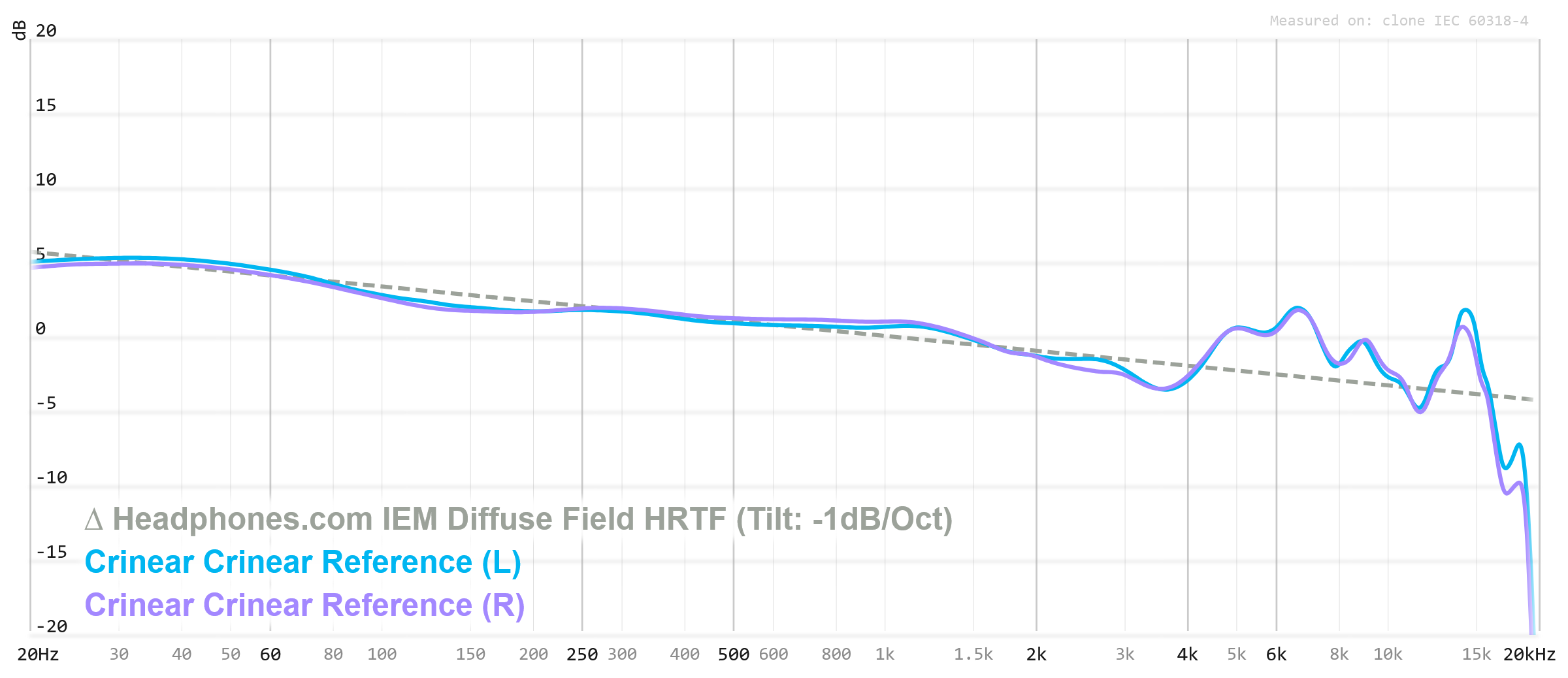
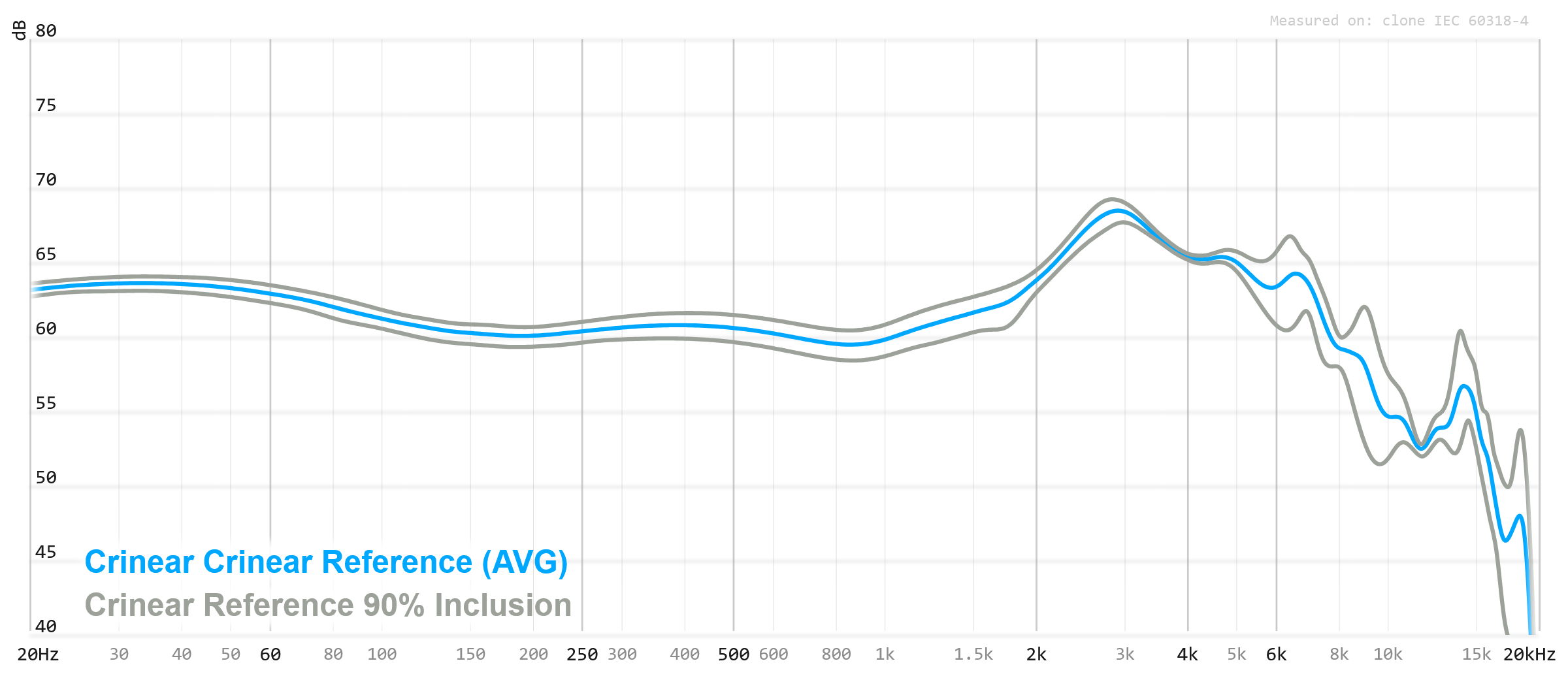
I’d like to point out that the bass has a level that I really enjoy. There is no sub-shelf to skew the balance to favor one portion of bass over the other. If you are used to hearing the same bass shelf of the new meta tunings or Harman targets, this might seem too little. But to my ears, this is absolutely bang on in terms of the level to how bass and sub-bass should be related towards, not only each other, but the rest of the frequency spectrum.
My only gripe would be the literal physical limitations of IEM’s. Sub bass is a frequency so low that is difficult to hear. At about 75 dB of volume these low frequency are starting to be felt. This really adds to the naturalness of bass and the literal physicality of low frequencies. While I acknowledge that is impossible for IEMs to do this, the dynamics and weight the Reference presents is on the weak side.
Midrange is where the Reference falls apart for me. There is an audible emphasis around 1 kHz that tends to push vocals forward. I get the purpose of this lift in other sets that boost their bass shelf and treble lift into oblivion to still retain some form of midrange excitement, but in the reference it does not fit for me. Since this region acts as a base for a lot of harmonic content, the balance here is not where I’d like it to be and it strides away from a natural sounding midrange.
That said, the biggest issue for me is the unfortunate dichotomy of tuning towards a population average. While in theory you would serve the most amount of people getting this right. There will always be outliers. I am one of those outliers. While the bass and the treble, which I will get to in a bit, are great. My unsymmetrical anatomy cannot agree with the ear gain tuning of this IEM. I can get up to a whopping 4 dB too much ear gain in my right ear depending on insertion depth. Deep fits are absolutely cooked while a very shallow fit mitigates a.
On energetic music which fills up about half of my favorite playlists, I can’t stand the reference. The immense glare and shout the set gives me makes it quite unbearable. The ear gain region is our most sensitive region since most sonic information for speech, localization and overall presence lives there. Getting blasted here is a little like a sensory overload. While I’m used to getting this phenomenon from bass or treble in other sets. This time, it is the other way around.
Treble is in contrast to the midrange, the best I’ve heard from headgear. While still not actually flat or reference level as claimed, I really can’t fault it since human anatomy varies drastically beyond 2 kHz. I still get a little too much lower treble and upper treble energy, but nothing that I would EQ out. It is still free from sibilance, lower treble sharpness or bad timbre. Everything still sounds very natural.
Conclusion
For a product being marketed as “flat” and “reference”, there still are many audible colorations throughout the entirety of the spectrum. However, this is easily one of the best sets I’ve heard. With the emphasis around 1 kHz paired with the lower and upper treble lifts to my ear, this set leans more towards clarity rather than note weight and dynamics.
If it weren’t for my personal anatomy differing so much from the used JM-1 population average for the ear gain, this would have been an absolute banger. I commend the certain immense effort it must have taken to bring a tuning like this to market. But at the end of the day, the hard truth is that not everyone will have the same experience even if the measurements are neutral on a B&K 5128 and JM-1 population average.
Score
Bass: 6 Mids: 4.5 Treble: 6
5.5/10